


ProbeNet Q1 2026 Expansion: Extending Into New Territories and Strengthening Island and Frontier Coverage
Get Unlimited Access to IPinfo Lite
Start using accurate IP data for cybersecurity, compliance, and personalization—no limits, no cost.
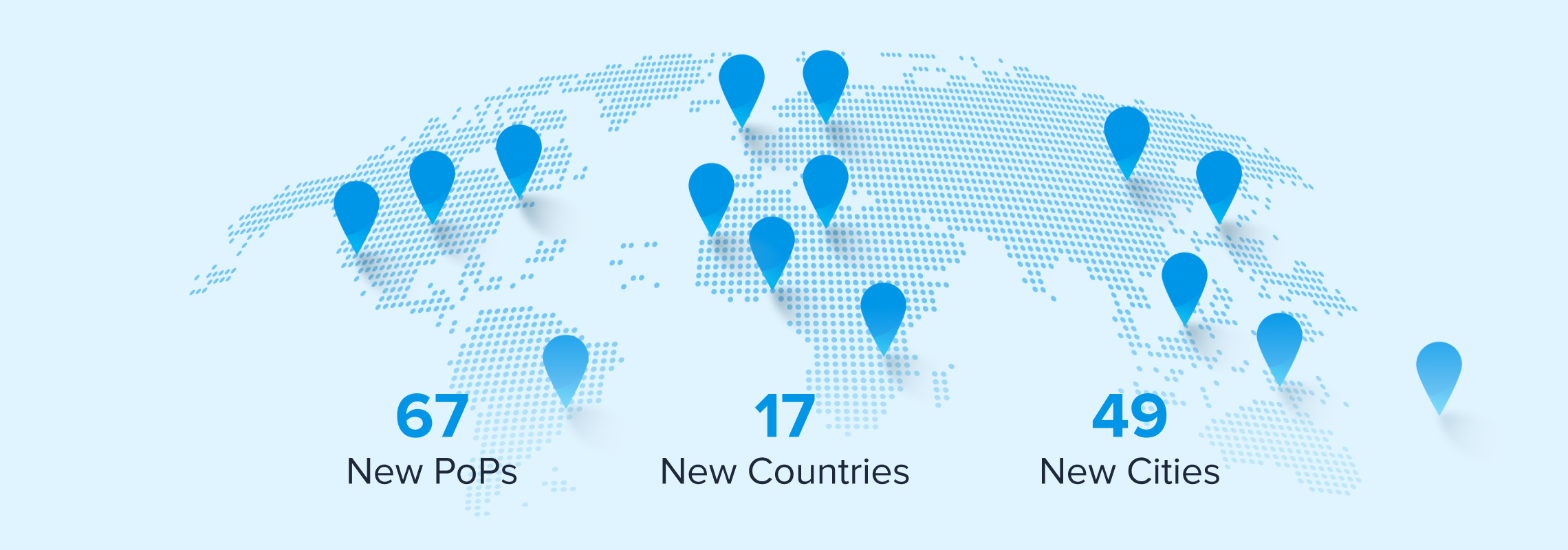
Sign up for freeIn Q1 2026, ProbeNet, IPinfo's internet measurement platform, expanded its global points of presence (PoPs) network with a strong emphasis on geographic diversification, pushing into 17 new countries and territories while continuing to build density in established markets.
We deployed 67 new monitoring PoPs across 41 countries and 63 cities, with a notable focus on island geographies, frontier regions, and underserved network environments.
This expansion strengthens ProbeNet's ability to validate internet behavior through active measurement, extending coverage into territories where measurement infrastructure is scarce and improving redundancy in high-demand markets.
Geographic Expansion: Island Territories, Frontier Markets, and Continued Core Density
Q1 deployments marked a significant shift toward geographic reach over pure volume. With 17 new countries and territories added in a single quarter, this was ProbeNet's most geographically diverse expansion period, reflecting a deliberate push into regions where reliable measurement infrastructure is difficult to establish.
Continental distribution (Q1 deployments)
- North America: 22 PoPs (32.8%)
- Europe: 15 PoPs (22.4%)
- Asia: 13 PoPs (19.4%)
- Africa: 10 PoPs (14.9%)
- Oceania: 5 PoPs (7.5%)
- South America: 2 PoPs (3.0%)
North America led Q1 in absolute deployments, driven by continued U.S. city coverage and meaningful expansion into Caribbean and Central American territories. Europe and Asia followed with steady additions, while Africa maintained its trajectory as a key growth region. Oceania saw proportionally significant gains through new Pacific Island coverage.
Continental Growth Impact
Comparing the points of presence footprint as of December 31, 2025 to March 31, 2026, Africa and Oceania saw the highest percentage growth, reflecting ProbeNet's continued investment in frontier and island regions:
- Africa: +16.1%
- Oceania: +15.2%
- North America: +7.1%
- Asia: +3.8%
- Europe: +3.2%
- South America: +2.5%
Top Countries by Q1 Deployment
Q1 expansion balanced continued investment in large internet markets with targeted deployments in new territories. Top countries by Q1 deployments:
- 🇺🇸 United States: 11
- 🇨🇳 China: 6
- 🇩🇪 Germany: 5
- 🇨🇦 Canada: 3
- 🇧🇸 Bahamas: 2 🇯🇵 Japan: 2 🇿🇦 South Africa: 2 🇧🇷 Brazil: 2 🇿🇼 Zimbabwe: 2
This quarter's distribution reflects two parallel priorities:
- Reinforcing core markets (U.S., China, Germany, Canada) with additional city-level coverage and path diversity.
- Establishing first presence in new territories across the Caribbean, Pacific Islands, Southern Africa, and Southeast Asia, building measurement capability where none previously existed.
New Countries and Territories Added in Q1
Q1 added ProbeNet coverage in 17 new countries and territories:
- 🇧🇸 Bahamas (BS)
- 🇧🇲 Bermuda (BM)
- 🇧🇳 Brunei (BN)
- 🇰🇾 Cayman Islands (KY)
- 🇵🇫 French Polynesia (PF)
- 🇬🇦 Gabon (GA)
- 🇬🇮 Gibraltar (GI)
- 🇬🇵 Guadeloupe (GP)
- 🇱🇮 Liechtenstein (LI)
- 🇲🇴 Macao (MO)
- 🇲🇻 Maldives (MV)
- 🇲🇪 Montenegro (ME)
- 🇳🇦 Namibia (NA)
- 🇳🇨 New Caledonia (NC)
- 🇵🇬 Papua New Guinea (PG)
- 🇸🇧 Solomon Islands (SB)
- 🇿🇼 Zimbabwe (ZW)
These additions represent a deliberate push into island and overseas territories (French Polynesia, New Caledonia, Guadeloupe, Maldives, Solomon Islands, Bermuda, Cayman Islands, Bahamas), small European states (Liechtenstein, Montenegro, Gibraltar), and Southern/West African markets (Zimbabwe, Namibia, Gabon). Many of these regions are strategically important for global topology visibility but historically underserved by measurement infrastructure.
New City Coverage: 49 Net-New Points of Presence
Across Q1, ProbeNet deployments introduced 49 cities that were new to the network, increasing local granularity across every continent.
Notable net-new PoPs added in Q1 include:
- Europe: Cork, Düsseldorf, Kassel, Klagenfurt, Podgorica, Jyväskylä, Schaan, Delft
- North America: Sacramento, Reno, Madison, Blacksburg, Fredericton, St. John's, Nassau, George Town, Hamilton
- Asia: Sapporo, Hiroshima, Shenyang, Dazhou, Changji, Huainan, Liuzhou, Pu'er, Bandar Seri Begawan, Macau, Male, Tripoli
- Africa: Harare, Windhoek, Libreville, Grand-Bassam, Centurion, Rabat
- South America: Cascavel, Rio Grande
- Oceania/Pacific: Wellington, Port Moresby, Honiara, Nouméa, Papeete
Strategic Infrastructure Development
Redundancy and Capacity Building
ProbeNet's ability to validate internet conditions improves not only with new geographies, but also with multiple PoPs per city, which increases reliability and expands the diversity of network paths we can observe.
By the end of Q1:
- 222 cities host multiple ProbeNet PoPs, up from 212 at the end of Q4
- That's +10 additional cities gaining redundant PoP coverage over the quarter
This multi-probe strategy supports:
- Higher reliability (reduced single-point dependencies)
- Greater path diversity (multiple providers / points of presence per metro area)
- Better monitoring capacity in critical hubs
IPv6 Readiness
Q1 continued ProbeNet's commitment to modern protocol coverage:
- 52.2% of Q1 points of presence (35 of 67) are IPv6-enabled
This investment helps ensure ProbeNet remains effective as IPv6 adoption grows globally, particularly in regions and networks where IPv6 behavior differs meaningfully from IPv4 (routing, latency, and peering patterns can diverge).
Diversified Provider Ecosystem
Q1 expansion significantly broadened ProbeNet's infrastructure partnerships:
- 47 providers were used in Q1 deployments
- 33 of those providers were new additions (first appearing in Q1)
This level of provider diversification, with 70% of Q1 providers being new to the ecosystem, reduces dependency on any single infrastructure source and improves the representation of our active-measurement points of presence across different hosting models, from large cloud environments to regional and local infrastructure providers.
Why This Matters: Better Vantage Points Make Better Verification
ProbeNet's core mission is to deliver empirical, active measurement that complements passive sources (registries, BGP, hosted signals, etc.) with observed internet conditions. Every new PoP increases the number of places we can measure from and every new country or territory added helps us better represent how the internet behaves locally.
Q1's expansion advances that mission in three practical ways:
- More geographic reach: 17 new countries and territories, extending measurement into island, frontier, and small-state regions
- More redundancy: 10 additional cities gained multi-PoP coverage, strengthening resilience in key metros
- More provider diversity: 33 new infrastructure partners, broadening the range of network environments we can observe from
Together, these improvements strengthen ProbeNet's role as a verification backbone for IP intelligence, supporting more robust measurement-derived insights across network mapping, behavior validation, and geolocation verification workflows.
Looking Forward
Q1 2026 expanded ProbeNet's footprint meaningfully, adding 67 new PoPs, introducing 49 net-new cities, expanding into 17 new countries and territories, and continuing to strengthen IPv6 and redundancy across the network.
As we move further into 2026, we'll continue to:
- Close remaining coverage gaps identified through measurement analysis
- Increase redundant city coverage in high-value hubs
- Expand partnerships to improve provider and path diversity, especially in underserved regions
- Keep investing in IPv6-capable measurement infrastructure as global adoption accelerates
Share this article


About the author

As the product marketing manager, Fernanda helps customers better understand how IPinfo products can serve their needs.