


What Black Hat 2026 Revealed About a More Complicated Security Landscape
Get Unlimited Access to IPinfo Lite
Start using accurate IP data for cybersecurity, compliance, and personalization—no limits, no cost.
Sign up for freeBefore Black Hat this year, I wrote a bit about what I was expecting to encounter.
There is no shortage of new technology trying to make security teams faster and more effective. AI was everywhere. Startups were everywhere. But promised innovations aren’t making the internet itself any easier to interpret.
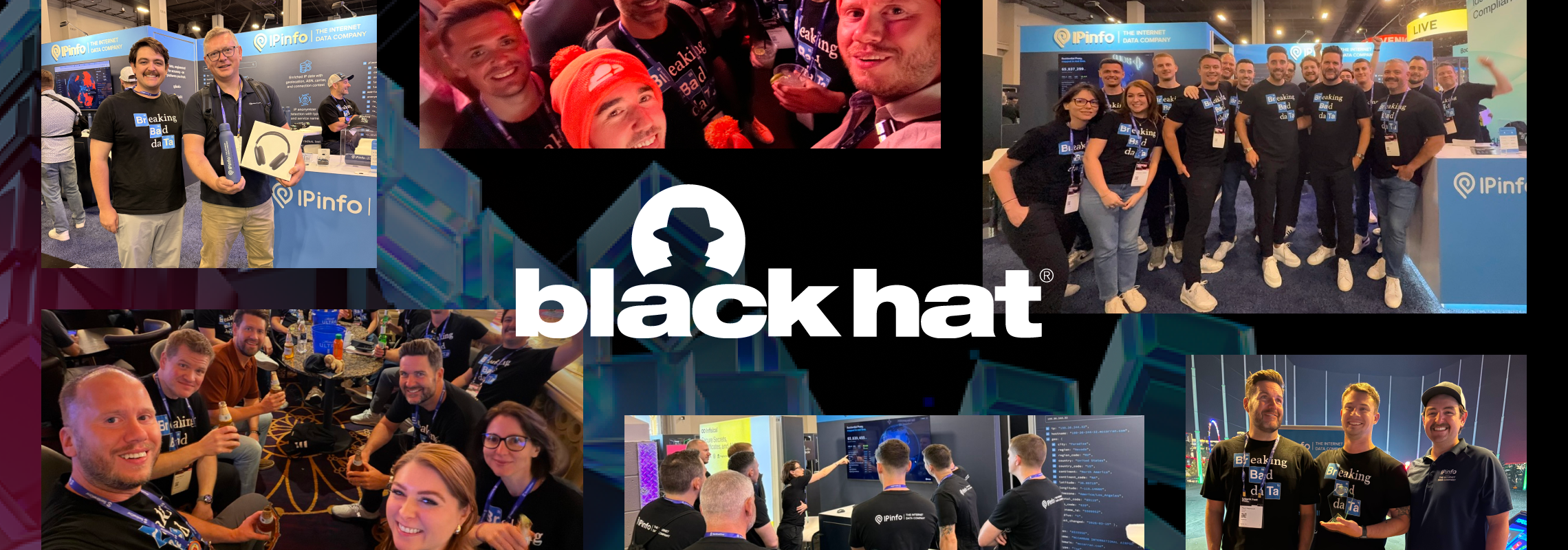
After a few days in Las Vegas and a lot of conversations at our booth, I heard firsthand how the problem space is becoming more complicated. The security leaders I spoke with kept returning to questions of trust: trust in the data informing their decisions, trust in increasingly automated workflows, and now, trust in the AI agents acting within their environments.
That last point feels particularly important. AI agents are emerging as another identity class that security teams have to govern. They can inherit permissions, interact with infrastructure, and take actions without a person making every individual decision. As that becomes more common, establishing what is actually behind a connection, what context surrounds it, and whether the underlying evidence can be trusted becomes even more consequential.
Security teams are automating more decisions at the same moment they're becoming less willing to take the underlying data on faith.
AI Makes Good Data More Important
It would have been nearly impossible to walk the Black Hat floor without encountering AI. More than half the exhibitors on the floor were selling AI or agents in some form.
But, contrary to much of the marketing I saw, most people wanted to speak with me about evidence. As AI becomes more integrated into security workflows, it magnifies the consequences of the inputs. That makes underlying trust in your data critical.
Also, the same capabilities that make AI useful to defenders make it useful to attackers. It can reduce the barriers required to launch sophisticated attacks and make malicious activity easier to scale.
AI makes mistakes, too. As it takes on a larger role in security decisions, the quality of the evidence underneath it, and the ability of people to understand and challenge those decisions, will matter enormously.
The Old Rules Don’t Apply
Residential proxies are a good example of what happens when a technically sound security rule meets a changing internet.
Many traditional detection techniques depend on assumptions about where traffic originates or what malicious infrastructure looks like. Residential proxy networks complicate those assumptions because traffic exits through consumer IP addresses.
A rule that worked well against datacenter proxies or obvious anonymization infrastructure may be far less effective when the same activity arrives through a residential network.
Reputation is largely a question about what an IP has done before. But a residential IP temporarily participating in a proxy network may have little history to find. It’s the IP’s behavior right now that matters, necessitating a different kind of context (like recency, frequency, and persistence indicators).
VPNs Show the Opposite Problem
VPNs demonstrate the inverse issue. A residential proxy can make potentially malicious traffic look ordinary. A blunt VPN rule makes perfectly ordinary traffic seem suspicious.
For millions of people, using a VPN is simply a normal consumer privacy choice. Yet I heard at Black Hat that VPN connections are still frequently handled with broad blocking rules.
That can create friction for legitimate users without necessarily stopping more sophisticated attackers. Again, the classification itself isn't enough.
Knowing that an IP is associated with a VPN is useful context. Deciding what that means requires understanding more about the connection, the service behind it, its behavior, and the environment in which you're seeing it.
Residential proxies and VPNs are very different problems, but they point toward the same limitation: binary labels become less useful as internet behavior becomes more complicated.
For more information about how different connection contexts influence security decisions, check out Founder and Co-CEO Ben Dowling’s recent webinar.
Trust Must Be Verifiable
The encouraging part of the conversations at Black Hat was that security teams seem aware of this problem.
If a piece of data is going to influence an automated decision, teams increasingly want to know where it came from, how recently it was observed, whether the behavior persisted, and whether they can test the conclusion themselves.
In other words, trust is becoming less about accepting an answer and more about being able to inspect the evidence behind it. Andy Ellis's widely-shared line at Black Hat was that the industry is "better at finding risk than fixing it.” Identifying risk is no longer enough. Teams must prove that the tools and data they rely on are actually helping them reduce it. I don't think that's necessarily a sign that security teams trust data providers less. I think the standard for earning that trust is getting higher.
That's why we expose our methodology and measurement, so our conclusions can be tested rather than taken on faith.
Introducing a More Granular Level of Geolocation
We’ve been working on Places for a long time, but this was the first event where we really got to talk about it. Places connects IP intelligence with physical place context (based on public wifi) to better understand where internet activity is occurring. It’s next-level geolocation.
People immediately started thinking about what becomes possible when a connection can be understood in the context of a venue, like a sports stadium or hotel.
Geolocation is valuable, but latitude, longitude, city, and country only describe part of the context behind a connection. As security problems become more complicated, understanding the service layer and the environment surrounding an IP becomes ever more useful.
Many Startups, Fewer Investors
Black Hat remains an impressive showcase for security startups.
There were a lot of them this year, and I was glad to see that level of experimentation and energy across the industry. At the same time, differentiating one company from another is getting harder. Once again, AI was at the forefront. The Startup Spotlight reduced hundreds of submissions down to four finalists, and the company that won both the USA competition and the new inaugural Global Startup Spotlight was Opnova, an agentic-AI platform that automates security, IT, and compliance operations.
I noticed fewer investors walking the floor than in previous years. That runs contrary to what I have seen quoted elsewhere, that cyber funding is healthy and offensive security in particular is attracting capital. Both can be true. Black Hat has always been the practitioner and researcher event; executives and investors increasingly gravitate to RSA, which is broader and more business-oriented.
That is precisely why Ben and I show up here every year. We would rather be judged by the people who actually pull our data apart than by the ones writing the check. If the practitioners at Black Hat trust what we build, the rest tends to follow.
Complexity Changes What We Need From Security Data
I left Las Vegas more convinced than ever that the assumptions we made about the internet even a few years ago need to be revisited.
AI is accelerating both sides of the security equation. Residential proxies are making familiar infrastructure-based rules easier to evade. VPNs show why simple classifications can create their own blind spots. AI agents are introducing another class of actors whose identity and activity security teams need to understand.
Meanwhile, we're going to see even more automation of security. AI will play a larger role in investigations, detection, and response. That’s why we have the highest standards for the data underneath those decisions.
The faster machines make decisions, the more important it becomes that people can understand why. The future of security may be increasingly automated. Trust can't be.
Thanks to everyone who stopped by our booth, challenged our thinking, showed us what you're working on, or simply came over to talk about the internet. Those conversations are always the most valuable part of Black Hat.
See you next year.
Share this article


About the author

As Co-CEO of IPinfo, Paul has spent two decades at the intersection of internet infrastructure and enterprise technology. He's previously held executive positions at Puppet, Dyn & Oracle, helping build and democratize access to the modern internet.